Introduction to Ryogoku: The Heartbeat of Sumo Culture in Tokyo
The train doors slide open at Ryogoku Station and bam – it hits you. Not the noise, though the JR Sobu line rattles overhead like a low-grade earthquake. It’s the air. It smells sweet. Wax. Bintsuke oil. The stuff wrestlers spackle into their hair. It coats everything here.
Ryogoku isn’t just a neighborhood; it’s a dedicated ecosystem for giants. You walk down the street and see guys the size of industrial freezers pedaling reinforced bicycles. It’s bizarre. Honestly, if you come to Tokyo and skip this because you “don’t like wrestling,” you’re an idiot. The aesthetic is Edo-period grit smashing into modern merchandising chaos. It’s not polished. It’s real.

The shopping? A mixed bag. Some of it is tourist trap garbage—plastic magnets, cheap keychains. But if you dig—if you actually look down the side streets and dodge the tour buses—you find gold. Hand-painted fabrics. Size-10XL underwear. Sweets that taste like soy sauce and sugar had a baby. Let’s get into it.
Ryogoku Edo Noren: The Polished “Station” Experience
Before you even leave the station building, you get sucked into Ryogoku Edo Noren.
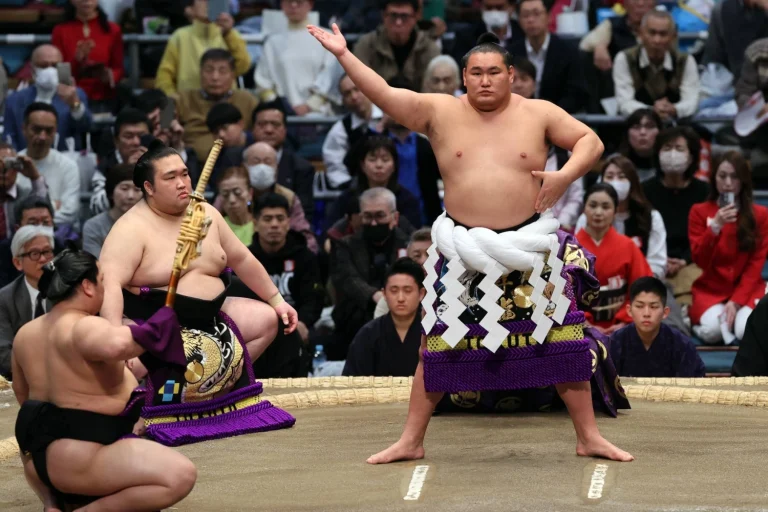
If the streets are the gritty, chaotic side of sumo, Edo Noren is the Instagram-ready cousin. Connected right to the West Exit. You walk in and the first thing you see is a full-sized dohyo (sumo ring). Smack in the middle. It’s a replica—professionals usually don’t wrestle here—but it sets the mood.
The shopping is higher-end. This is where you go for a gift for your boss or a picky parent.
- Takumi-no-hako: Traditional crafts. Think beautiful wooden cups, high-quality fabrics, items made by actual Edo artisans. Less “cartoon sumo,” more “elegant tradition.”
- The Sake Tasting: There’s a vending machine wall of sake. Coin in, cup fills. Dangerous. Sip some local brews while staring at the ring.
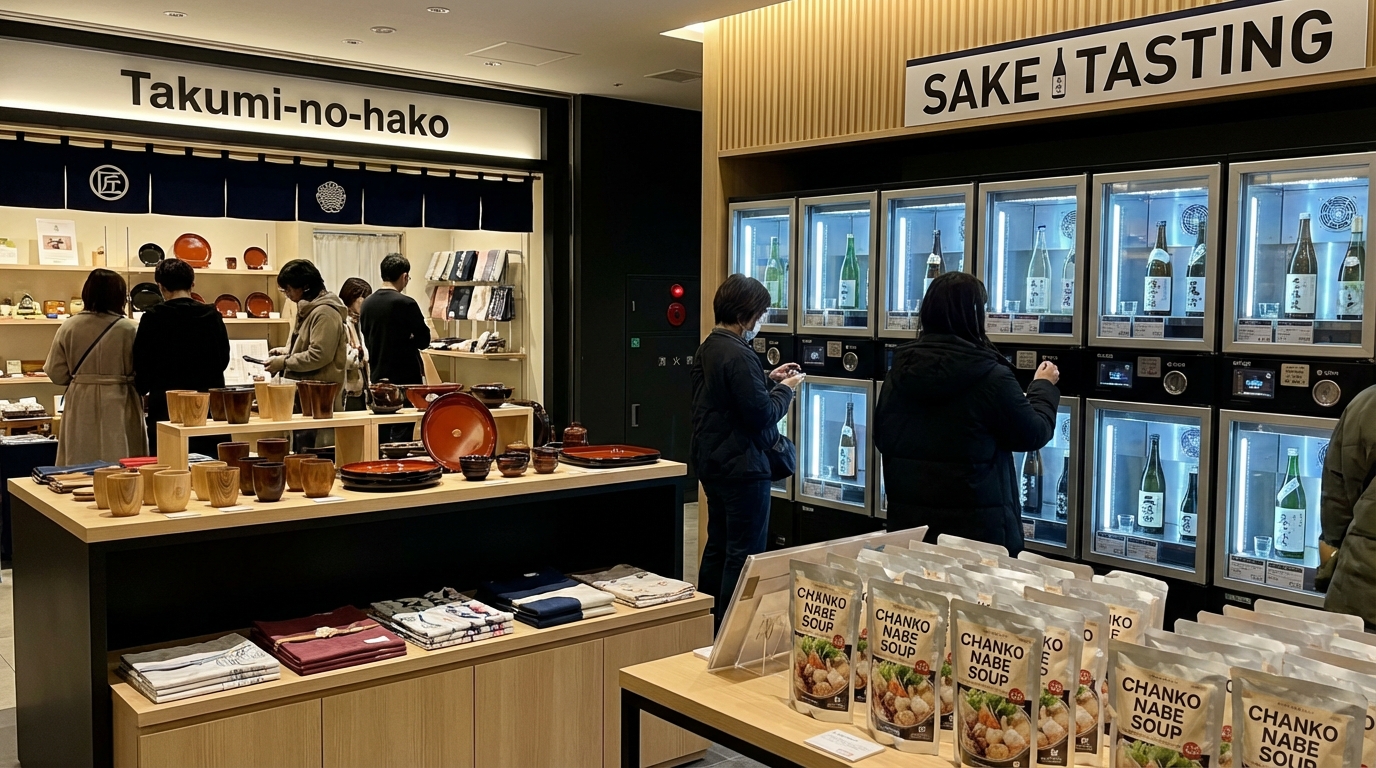
The must-buy item? Chanko Nabe soup packs. Chanko is the massive protein stew wrestlers eat to bulk up. You can buy the broth pouches here. Don’t worry, eating it once won’t make you gain 50 pounds. Probably.
Ryogoku Takahashi: The “Department Store” for Sumo Souvenirs and Daily Goods
This place is a disaster in the best way possible.
Located just south of the station, Ryogoku Takahashi calls itself a “department store,” which is a hilarious lie. It’s more like a hoarders’ den organized by someone who maybe gave up halfway through. And I love it.
You walk in and the shelves are groaning. They have everything. Towels, tea cups, stickers, socks. But the real reason to go here isn’t the generic stuff. It’s the cushions. They sell the zabuton—the floor cushions people throw at the ring when a Yokozuna loses. Well, maybe not the exact ones, but close enough.
AI Planning your trip? Ask AI Tokyo Concierge
Get personalized help based on this guide, your travel dates, budget, and plans.

The vibe is distinctly “local.” You might find an elderly shopkeeper who speaks zero English but will enthusiastically point you toward the newest wrestler-themed socks. It feels like a neighborhood hardware store, except instead of hammers, they sell bath salts that promise to make you sweat like a rikishi.
I bought a small coin purse here once. It fell apart in three months. Still have it. Charming.
The Kokugikan Official Shop: Exclusive Tournament Merchandise and Banzuke
Here is the tricky part. The Kokugikan (the actual arena) is a fortress. If there’s a tournament happening – January, May, September – you need a ticket to get inside the main merchandise area.
If you do have a ticket? Prepare for war. The lines are insane.
The absolute holy grail item is the Banzuke. The official ranking list, written in that thick, calligraphic “Sumo-ji” script that is practically illegible even to Japanese people. Printed on thin, fragile paper. Smells like ink and tradition.
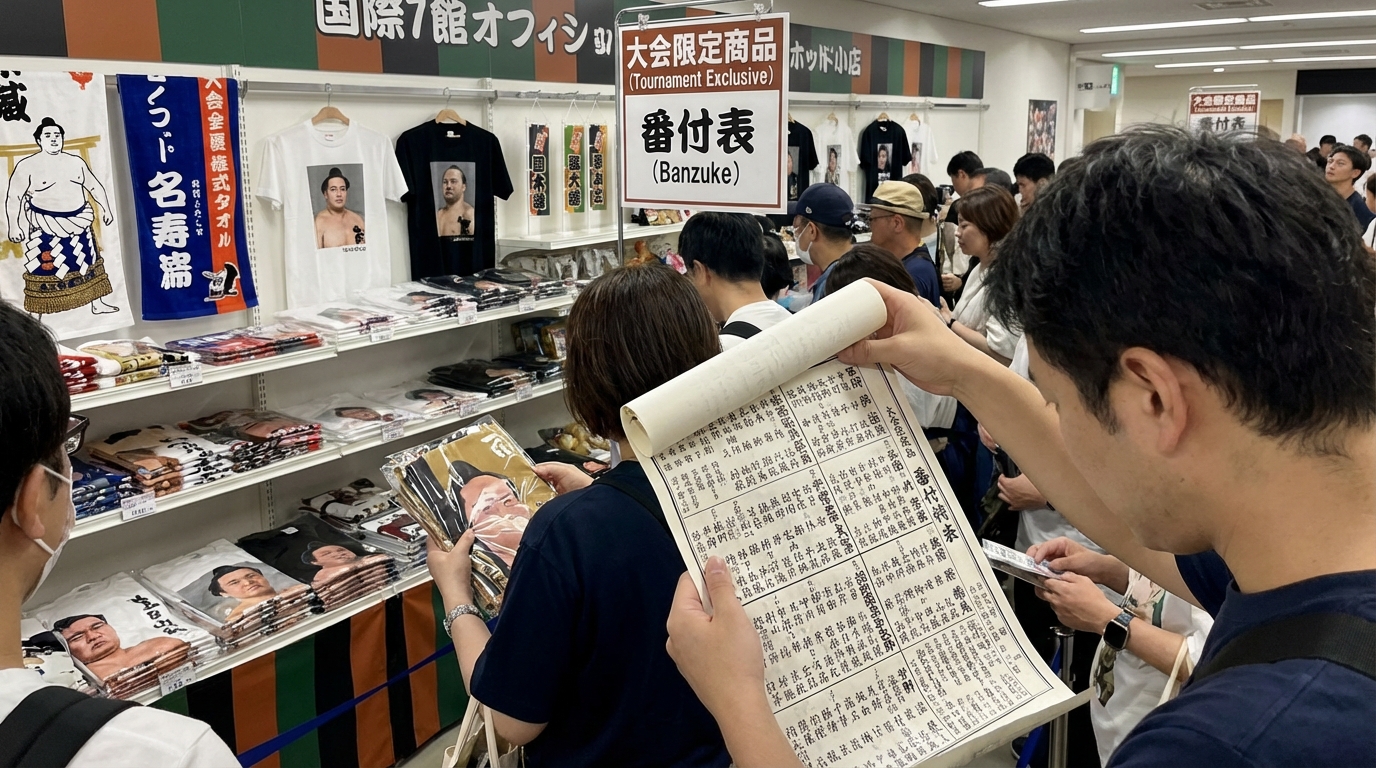
They sell them for dirt cheap – usually around 55 yen. Buy five. They crumple if you look at them wrong, so bring a hard folder. I’m serious. I ruined a pristine Banzuke by shoving it in my backpack next to a water bottle. Rookie mistake.
Besides the paper, they sell the official wrestler towels. You’ll see fans waving these during matches. If you want to fit in, buy the towel of the guy everyone else is cheering for. Or be a contrarian and buy the towel of the guy who’s about to lose. Your call.
The “Konbini” Hunt: Hidden Gems in Convenience Stores
Here is a tip most guidebooks miss: Don’t ignore the 7-Eleven or New Days (the station convenience store).
In Ryogoku, the convenience stores get weird. During tournament seasons (January, May, September), they transform. The 7-Eleven near the station often dedicates entire shelves to sumo goods that are cheaper and easier to find than in the specialty shops.
Look for:
- Sumo Magazines: Even if you can’t read Japanese, the photography is incredible.
- Trading Cards: The New Days at the station often stocks BBM Sumo Trading Card packs. They cost a few hundred yen. You open them like Pokémon cards, hoping for a foil-signed card of a Yokozuna. Surprisingly addictive.
- Seasonal Snacks: You’ll often find potato chips or chocolates with sumo branding that you can’t find anywhere else in Tokyo.
Lion-Do: Authentic King-Sized Apparel and Traditional Sumo Underwear
Lion-Do is fascinating. It’s a “Big & Tall” store, but specialized for the sumo physique. We are talking sizes that don’t exist in the normal world. 8L. 10L.
The shop window usually displays a pair of trousers that could house a small family of four.
It’s located on the corner, hard to miss. What’s cool is that actual wrestlers shop here. You’re browsing for a souvenir t-shirt, and suddenly the light gets blocked out by a 400-pound teenager looking for shorts.
The must-buy item? Suteteko. These are the traditional long underpants/shorts things wrestlers wear under their yukata. Breezy, comfortable, and absolutely massive. Buying a pair is a great novelty gift, or honestly, just great pajamas.

They also sell mawashi (the loincloth belts), but… unless you’re planning to start training, maybe skip that. It’s a lot of heavy canvas to drag home.
Chikarayama Shoten Yorikiri: Unique Accessories Made from Recycled Sumo Banners
This is my favorite “hidden gem” spot.
You know those colorful banners (Nobori) that flutter outside the stadium during tournaments? The ones with the wrestlers’ names? They don’t last forever.
Chikarayama Shoten Yorikiri takes the old, discarded banners and upcycles them. They turn the fabric into tote bags, coin cases, card holders.
The texture is rough—heavy cotton, weather-beaten, dyed with bright, thick ink. Because they are made from actual banners, every single item is one-of-a-kind. One bag might have the bottom stroke of a kanji character; another might just be a splash of red and blue.
It’s right across from the Arashio stable (the one with the big window where you can watch practice). You go watch the morning practice, feel guilty about eating breakfast while they starve, and then cross the street to buy a bag made of their names.
The “Kawaii” Side: Hiyonoyama and Character Goods
Sumo is a brutal sport involving violent collision, so naturally, the Japan Sumo Association created a mascot that is an adorable yellow bird.
His name is Hiyonoyama. He has a rival, a red bird named Akawashi. You will see these birds everywhere. If you are traveling with kids, or just like cute things, you need to find the Hiyonoyama merch.
You can find plushies, notebooks, and socks featuring this round, happy bird at the official shops (and sometimes at Takahashi). It’s a hilarious contrast to buy a plush toy of a bird wearing a mawashi right next to a gritty print of a wrestler throwing salt.
Gachapon: The 500-Yen Souvenir Gambling Fix
If you’re on a budget, or just have a lot of loose change, look for the Gachapon (capsule toy) machines.
There are banks of these machines inside Ryogoku Station and near the Kokugikan entrance. They release new series constantly.
- Miniature Wrestlers: Tiny plastic figures of famous wrestlers in mid-throw.
- Sumo Meals: Miniature plastic replicas of Chanko nabe.
- Sekitori Pouch: Small drawstring bags that look like different wrestlers’ aprons.
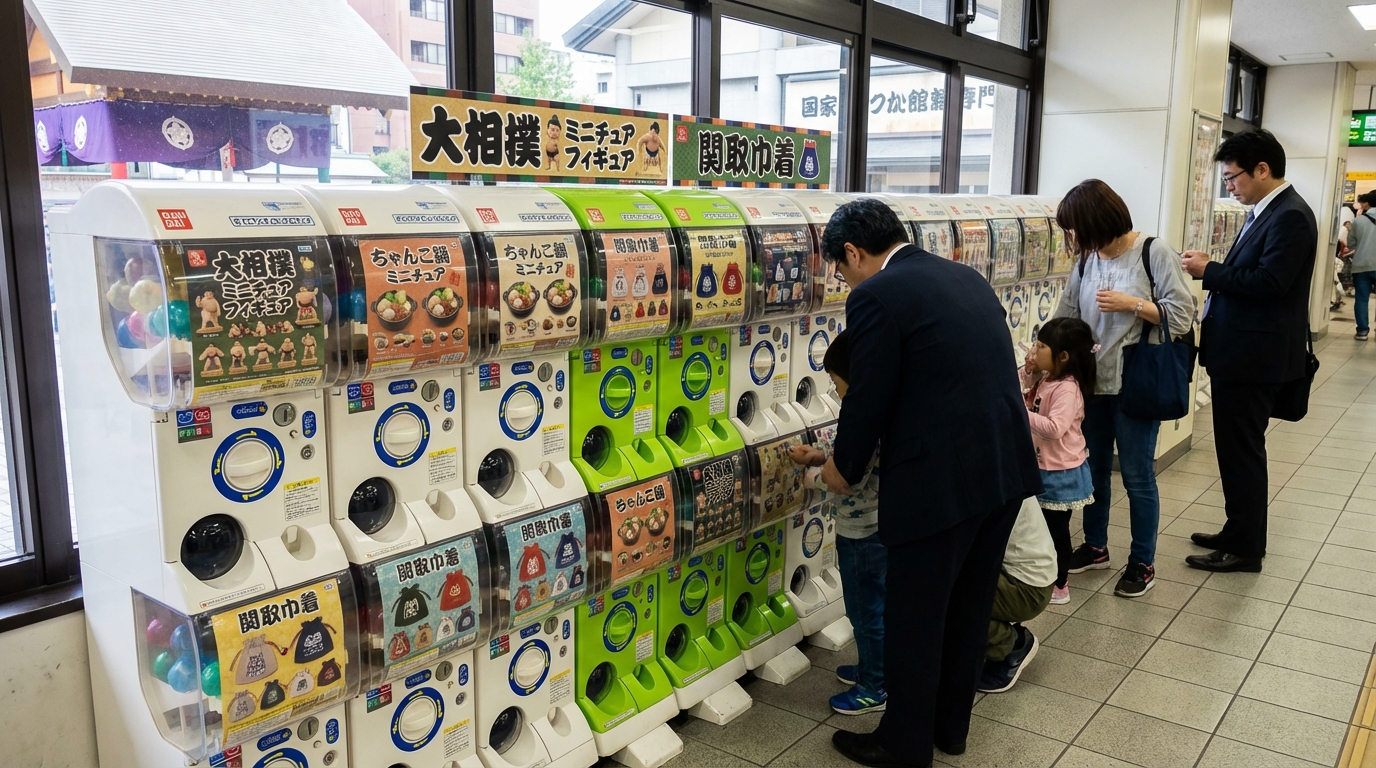
It’s low stakes gambling. You want the Terunofuji figure, but you keep getting the referee. That’s life. Keep spinning.
Ryogoku Kokugikido: Must-Buy Sumo-Themed Sweets and “Anko Arare”
Sweets in Japan can be hit or miss. Sometimes they look like art and taste like chalk.
Ryogoku Kokugikido is famous for Anko Arare.
Imagine a rice cracker (arare). Usually salty, right? Now, coat it in red bean paste (anko). Sounds weird. Sounds like a mistake. It is, surprisingly, addictive.
The texture is crunchy, then soft, then sweet, then salty. Messes with your brain. They look like little dark clumps—not the most photogenic snack—but they are the quintessential Ryogoku souvenir.
The shop has a tearoom upstairs. If you’re tired of walking, go up, order some matcha and the Anko Arare set. Good place to sit and stare out the window, watching tourists get lost.
Authenticity Check: How to Identify Real Tegata (Handprints) vs. Replicas
You will see Tegata (handprints) everywhere. A big hand slam, red or black ink, a signature.
99% of what you see in souvenir shops are fakes. Printed copies.
How to tell the difference:
- The Ink: Look closely at the handprint. Is it flat? Uniform? It’s a print. Real tegata have ink that bleeds into the paper fibers. You should see lighter spots where the palm didn’t touch as hard, and darker pools where the ink gathered.
- The Signature: A real signature looks wet, or at least has brush strokes that vary in thickness and speed. A printed signature is flat black.
- The “Perfect” Problem: If the handprint looks perfect—no smudges, perfectly centered, every finger clearly defined—it’s fake. Real human hands are messy. Wrestlers slapping a board make mistakes.
- The Stamps: High-ranking wrestlers (Yokozuna, Ozeki) will often stamp their seal in red.
If you’re paying 500 yen ($3-4), it’s a print. Real ones cost hundreds of dollars, usually. If you just want a cool decoration, the prints are fine! Just don’t get scammed thinking you bought a Hakuho original for the price of a sandwich.
Sumo Museum Shop: Finding Rare Collectibles on Non-Tournament Days
If you visit when there is no tournament (which is most of the year), the main stadium is closed. But the Sumo Museum—attached to the building—is usually open. And free.
It’s small. One room, basically. They rotate exhibits. Sometimes it’s “Aprons of the 1980s,” sometimes “Old Woodblock Prints.”
The shop here is the reliable backup. Stocks the basics. Keychains, clear files, maybe some t-shirts. It doesn’t have the chaos of Takahashi or the exclusivity of the tournament-only stalls, but it’s official.
Warning: They close early. Like, 4:00 PM or 4:30 PM. And they are randomly closed on weekends sometimes. Check the schedule before you trek out there.
Online Options: Where to Buy Official Sumo Goods When You Can’t Visit Ryogoku
Maybe you forgot to buy something. Maybe you’re reading this from Ohio.
- SuMALL: This is the official Japan Sumo Association online store. It’s… okay. The site navigation can be clunky. They have the official goods—the towels, the plushies of Hiyonoyama (the bird mascot).
- BigSUMOfan: If you are outside Japan, shipping from SuMALL can be a nightmare. BigSUMOfan is a US-based site that imports the stuff. You pay a markup, obviously, but you don’t have to deal with Japanese customs forms or navigating a website that Google Translate is struggling to parse.
- Mercari / Yahoo Auctions: If you want the real stuff—vintage tegata, old banzuke—this is where you go. But it’s the Wild West. Refer back to the “Authenticity Check” section. Lots of “rare” handprints on there that were printed on an inkjet in someone’s basement last week.
Shopping in Ryogoku is less about the item and more about the hunt. It’s cluttered, it smells like hair oil, and it’s perfect. Buy the ugly towel. You won’t regret it.